Lately I keep hearing the same question, in different forms:
“Will AI make SaaS irrelevant?”
“Will companies just build everything themselves?”
“Is this the end of enterprise software?”
I don’t think that’s the right way to frame the problem.
AI clearly makes it much easier to build software. That part is obvious. I built a few in the past few months, mostly for fun. I never code before AI made it possible, but I built several OK apps in the past 1 year. My github commit
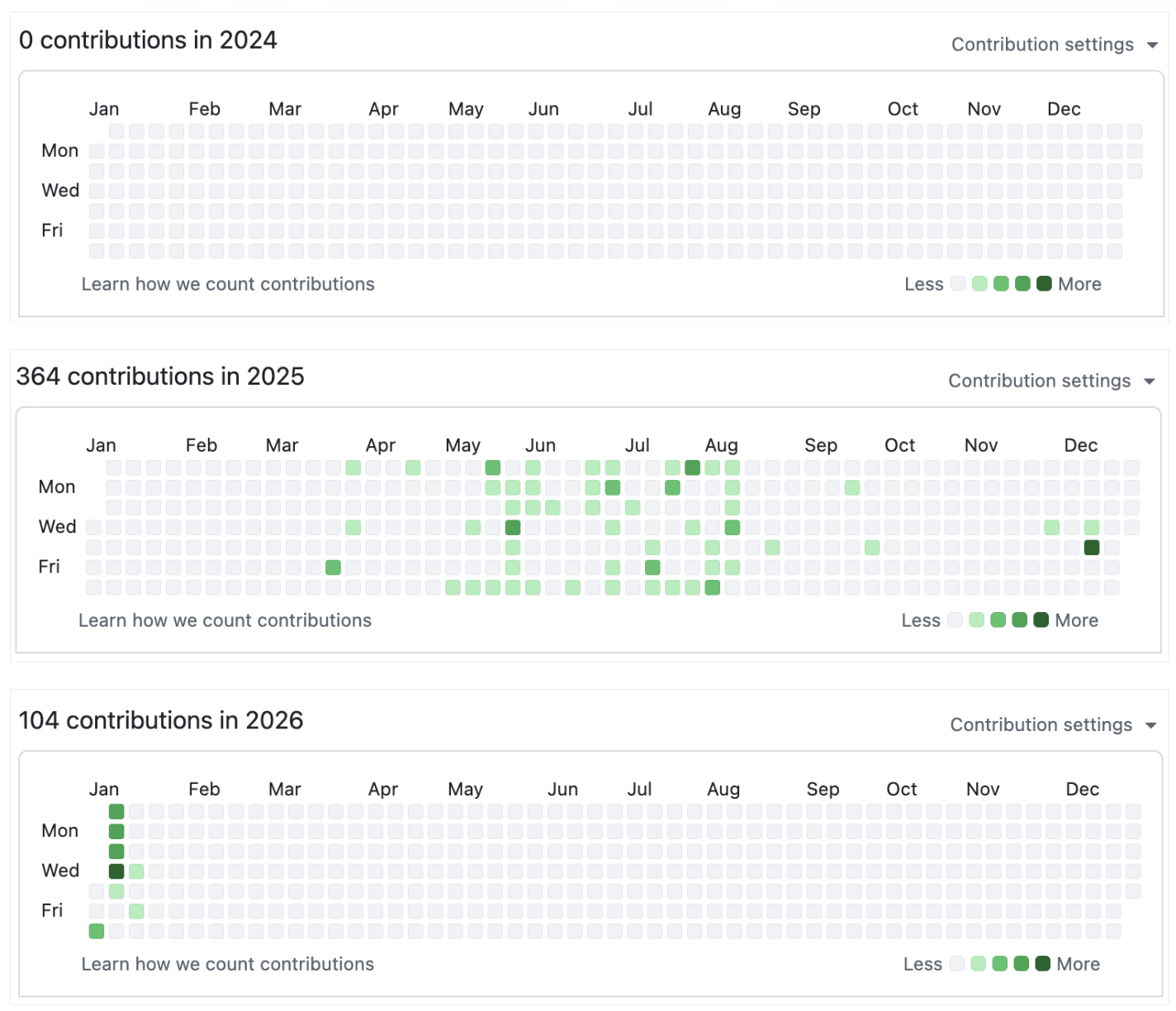
But running a company on software is a very different problem. And most discussions mix those two up.
Building software got cheap. Owning it didn’t.
There are two costs in software:
One is the cost to create something that works.
The other is the cost to keep it correct over time.
AI collapses the first one.
The second one barely moves.
Keeping software “correct” means things like:
- data still makes sense after years, not weeks
- permissions don’t break when people move teams or leave
- audit logs are still usable when someone asks questions later
- workflows change without destroying history
- compliance rules change and the system survives
Most internal software doesn’t fail because it couldn’t be built.
It fails because nobody wants to carry this ownership burden for years. Jason Lemkin of SaaStr said “…shipping a v1 is maybe 2% of the work”!
That’s why I’m skeptical of the idea that “AI will replace SaaS because everyone can build software”. It assumes software is static. In reality, business software keeps accumulating responsibility.
A simpler way to look at enterprise software
Over time, I’ve found it useful to think about enterprise software in four layers. They often come bundled together, but they behave very differently.
System of Record (SoR): where truth lives
This is payroll, accounting, compliance records, contracts, official documents.
The goal here is not speed or UX. It’s correctness.
Mistakes at this layer are not annoying. They’re legal, financial, sometimes existential.
That’s why the buyers are usually CFO, CIO, legal, finance.
AI doesn’t replace this layer.
In fact, the more automation you add, the more you need a clean, trusted source of truth underneath.
AI can write code.
It cannot magically produce trust.
System of Engagement (SoE): where pressure shows up first
This is the interaction layer: dashboards, forms, workflows, the screens people click every day.
This is where AI feels most disruptive.
Natural language interfaces, copilots, agents — all of these reduce the need for traditional UI.
You say what you want, instead of clicking through ten steps.
This is also where thin-layer SaaS lives.
By thin-layer SaaS, I mean products that are mostly:
- interface
- light workflow
- basic CRUD
- surface-level reporting
These products exist because software used to be expensive to build.
When building becomes cheap, “thin SaaS” loses leverage unless it moves deeper.
This is where a lot of the fear about “AI killing SaaS” actually comes from.
System of Intelligence (SoI): AI is strong here, but dependent
This layer turns data into insight: predictions, recommendations, anomaly detection, prioritization.
AI is naturally good at this. This layer will move fast.
But it has a hard dependency: garbage in, garbage out.
If your data definitions are messy, permissions unclear, records unreliable,
the intelligence layer looks confident but makes the wrong calls.
So intelligence grows, but it quietly increases the value of a clean record layer underneath.
System of Action (SoA): where economics really change
This is the execution layer: approvals, follow-ups, reconciliations, triggers, workflows that actually do things.
Here, AI doesn’t just help the system.
It becomes the system.
This is where seat-based economics get pressured.
If fewer people can do the same amount of work, growth tied purely to headcount stops working.
The value shifts from “number of users” to “work completed” and “outcomes achieved”.
This doesn’t mean the software disappears. It means the pricing model and value story have to evolve.
SaaS can stay essential and still struggle
This is the uncomfortable part.
A system can remain critical to a company and still stop growing the way it used to.
AI budgets are growing fast. Total IT budgets are not growing at the same speed.
That gap gets funded somewhere:
- fewer seats
- slower expansion
- fewer new apps
- more pressure to consolidate vendors
So relevance doesn’t automatically mean easy growth anymore. Both things can be true at the same time.
A note on Mekari
This is something I’ve had to internalize as an ‘operator’.
Mekari sits mostly in the System of Record layer: employment data, payroll, accounting, compliance, official documents. These are areas where mistakes are quiet but expensive.
As companies add more internal tools and more AI-driven automation, they don’t stop needing this layer. If anything, more systems end up reading from it and writing back to it.
That doesn’t mean the job is done. It means the challenge shifts.
The risk isn’t replacement. The risk is failing to adapt how value is delivered — especially when seats are under pressure and customers expect real, measurable outcomes, not just “AI features”.
Where this leaves SaaS
AI doesn’t kill enterprise software. It kills thin-layer SaaS that only owns the surface: nice UI, light workflow, little responsibility for truth or outcomes.
AI raises the bar for everything underneath: data integrity, governance, reliability, execution.
AI makes software easier to create. It does not make business reality easier to own.
That gap is where serious SaaS still lives.